 Calm to the waves. Calm to the wind. Jesus whispers, “Peace, be still.” Balm to our hearts. Fears at an end. In stillness, hear his voice. ~ Mary Louise Bringle
Today in Vacation Bible School, the children made sensory gel mats for children in a local care center. They are simply clear zipper bags filled with gel and fun small objects like Pom Pom balls, buttons in fun shapes, foam letters, and glitter. I tried them out, and they are quite mesmerizing! I can understand how helpful they are in bringing a sense of calm to children. When I gaze at a body of water, I feel a sense of calm, and in that vast place of peace, I sit with God.
Dear Lord, today I thought of the words of Vincent Van Gogh: “It is true there is an ebb and flow, but the sea remains the sea.” You are the sea. Although I experience many ups and downs in my emotions and often feel great shifts and changes in my inner life, you remain the same. Your sameness is not the sameness of a rock, but the sameness of a faithful lover. Out of your love I came to life; by your love I am sustained; and to your love I am called back. There are days of sadness and days of joy; there are feelings of guilt and feelings of gratitude; there are moments of failure and moments of success; but all of them are embraced by your unwavering love. My only real temptation is to doubt in your love, to think of myself as beyond the reach of your love, to remove myself from the healing radiance of your love. To do these things is to move into the darkness of despair. O Lord, sea of love and goodness, let me not fear too much the storms and winds of my daily life, and let me know that there is ebb and flow but that the sea remains the sea. Amen. ~ Henri Nouwen
 I am thankful for our Christian Educator and the creativity she brings to children of all ages. This was day two of Vacation Bible School, and our story was about Moses and the burning bush. As we all gathered before dispersing to various age groups, the story was acted out by the children. Never have I seen a burning bush like this before. It cannot be adequately described, but it involved one child in golden sparkly shorts, eight “flaming” arms, and lots of imagination. This familiar Bible story was brought to life in a way that I and those present are likely not to forget.
 “You git what you git, and you don’t throw a fit”…words chanted by a six year old after receiving his food at a restaurant. I overheard this child while returning from the monastery a few days ago, reminding me of my daily readings. As an oblate, I read portions of The Rule of St. Benedict each day. This guide, primarily written for monks and rooted in scripture, has proven to be relevant to people of all classes of society for fifteen hundred years. The Rule contains principles for working together and living together, and a sense of humor is speckled throughout. When Benedict says, “There must be no word or sign of grumbling,” it reminds me of my own family life growing up, and the occasional, sometimes frequent, arguing with my siblings. How hard it would be not to grumble!
 After staying at the monastery, I visited Saint Benedict’s Brew Works. When I first heard of beer described as liquid bread, I thought deeply about the bread I bake. I even thought, “Could it be possible that Jesus’ miracle of the feeding of the 5,000 involved liquid bread?” When bread is created or a substance is brewed, the ingredients mingle and ruminate together, and over a period of time, transformation occurs. We may hear and speak God’s Word, but unless we are willing to change, we only hear and see. When we ruminate on God’s Word and live God’s Word, we open ourselves to the miracle of transformation.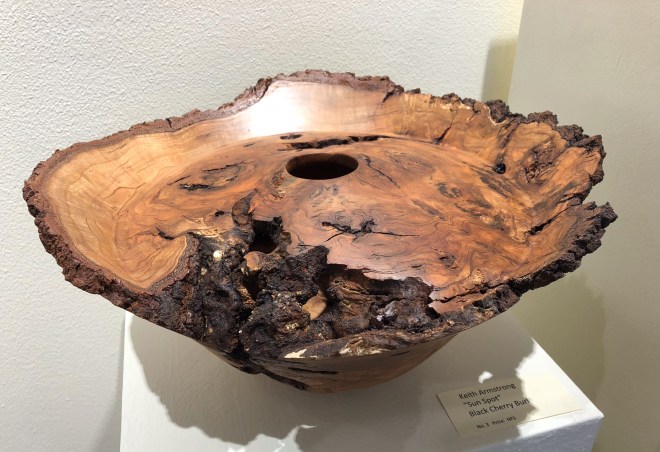
 My phone’s alarm seems to be in a different time zone than my phone’s clock (same device, how does that happen?) so it woke me at 3:45 a.m. today for 5:30 Vigils and Lauds. At that hour I don’t usually rejoice in much, but from my window I watched the night sky gradually glow as the sun crept closer toward the horizon. I also listened to the rhythmic peal of the tower bells praising God at 5:15 a.m. For those things I do rejoice.
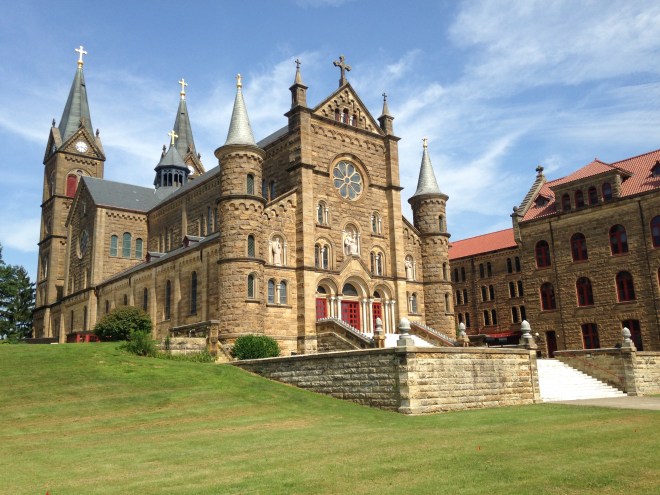 I will be staying at a monastery for the next several days to spend more focused time with God and refuel a bit. During this time I will continue to write as part of my evening prayer, but I will not engage in social media or respond to emails and texts. When I first visited Saint Meinrad Archabbey, I “unplugged” for the week, which I believed was vital to giving God my full attention. Sure, it can be boring at times, but that’s not bad. When I feel that way, and allow myself to unveil my vulnerability a little, this is when the light of Christ is able to shine through and enter my life more deeply. But I have to allow that to happen. It can be difficult at times to just sit with God. Sometimes it feels as if not much is happening, yet these times of “nothingness” are so important to spiritual growth. I have come to long for these opportunities to get away and not be tempted to bake, do laundry, or weed because I know that God is cultivating a much more important garden in my soul.
 Our daughter is having a difficult time finding an apartment within important parameters like cost, distance to work and school, and transportation options. Life becomes more complicated the older we get. When she was a child, I took road trips with her. We had such fun traveling across the country to visit grandparents on the East coast. One such visit, over dinner, we were having a conversation on a topic I do not recall. What I do remember is a charming misunderstanding. Grandpa exclaimed, “Ah well, C’est la vie”. To which our daughter responded, “Lovey.” I will never forget the laughter, and our daughter’s quizzical look wondering what was so funny. She’s heard this story retold many times over the years, and I hope that by hearing it again we might share a bit of laughter. Like life, throughout her apartment search, there will be bumps along the way and more road trips in search of another place to live. Remembering back to times of innocence in our lives, we realize how we’ve grown in many ways. And at some point, we laugh at fond memories and realize that, although big deals at the time, those become smaller and smaller as we grow. Such is life.
 Bread for the Journey